
Turn intention into everyday action.
Habit building for an intentional Muslim life
Choose your niyyah, one doable action, and a familiar moment. Build a rhythm you can return to.
What matters to you?
Choose an area. Explore a small beginning.
One possible beginning
- Niyyah · your why
- To make space for Allah’s words in my day.
- One doable action
- Read one page.
- A familiar moment
- After Fajr.
An example, not a prescription. Exploring changes nothing in your plan.
Practical habit science. A life shaped by niyyah.
Research points to a practical place to start: repeat a manageable action in a familiar context. Dayma turns that into a cue, an amount, and a schedule you can choose.
Islam gives us a reason to care about both the intention and the deed. Dayma brings that meaning into your plan, with room for small, consistent good across your life.
Make the start easier. Keep the intention conscious.
The principles behind the approach
Practical guidance for building a habit, with Islamic grounding for its meaning.
- Making health habitual
Gardner, Lally & Wardle, 2012. Manageable actions, stable contexts and repetition.
- Sahih al-Bukhari 1
The place of intention in our actions.
- Sahih al-Bukhari 6464
The value of consistent deeds, even when small.
These sources inform design principles. Dayma has not been clinically tested, and no habit timeline or spiritual outcome is promised. Dayma is independent of Atomic Habits and James Clear.
Give your intention a place in your day.
You choose the why, the action and the rhythm. Dayma helps you keep them together.
Choose what matters.
Begin with a life area and a private niyyah: why does this practice matter to you?
Make one action doable.
A page, a few minutes, one act of care. Choose an amount small enough to begin.
Give it a familiar moment.
After a prayer, in the morning or before sleep. Choose a cue and a schedule that fit your life.
Review. Adjust. Return.
Notice what happened. Change the amount, pause or simplify when needed. Your plan can change with you.
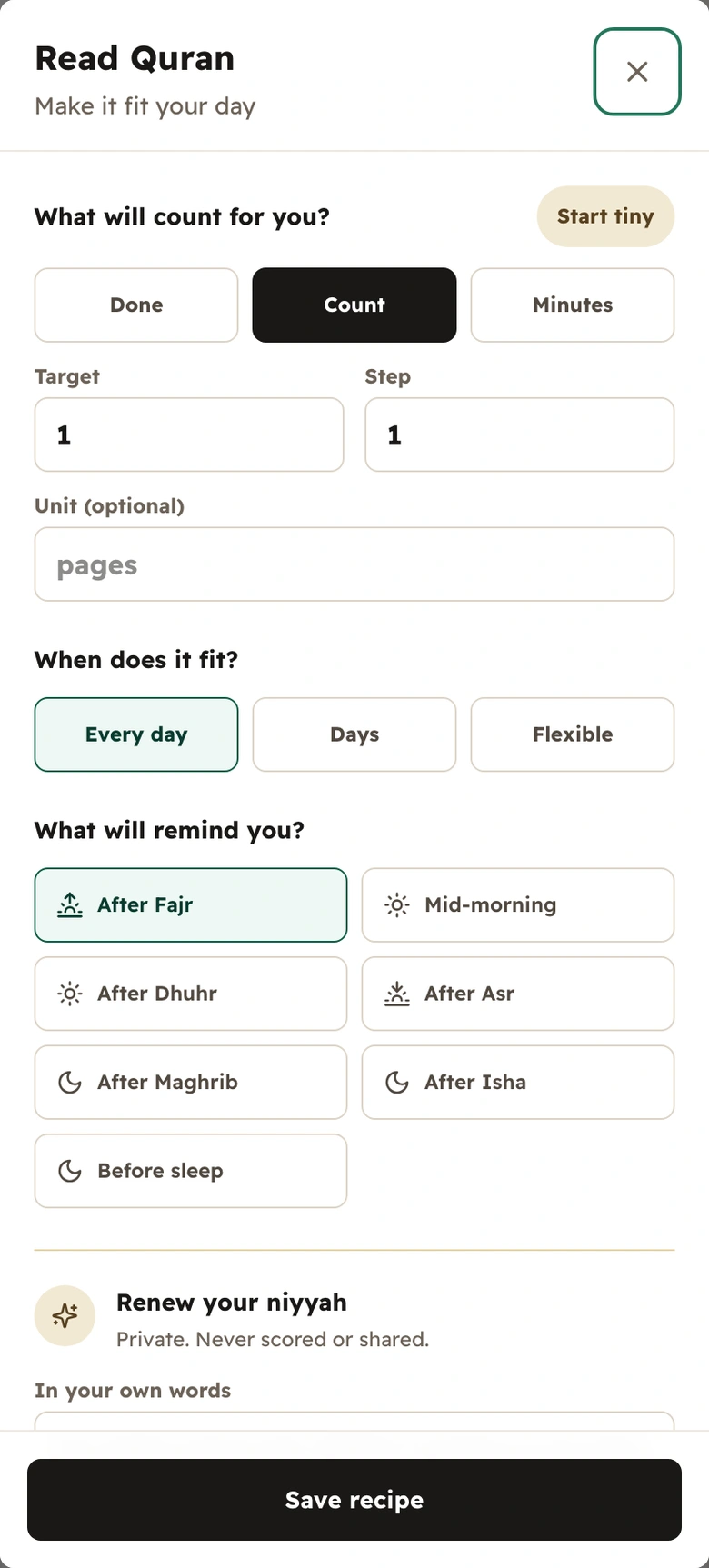
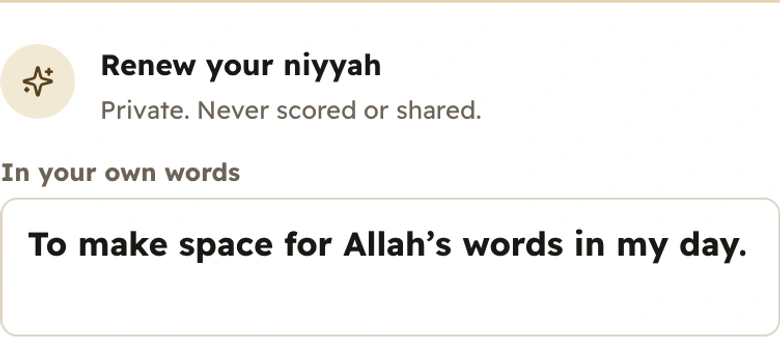
Actual Dayma screens with illustrative data, not someone’s account. The niyyah field is shown further down the same editor.
Your practice. A little company, if you want it.
Invite family or friends into a private Circle for a shared practice. Each person chooses to join; your own plan stays your own.
Circle members don’t see your niyyah, Journal, amounts or unrelated practice names. Broader daily activity sharing is opt-in, from the local day you consent. An optional account enables Circles and private backup.
Read the privacy policyBefore your first small step.
How is Dayma different from a tracker?
Start with what matters, not a checklist: choose a practice, a private niyyah, a doable amount and a familiar cue. Recording helps you review and adjust. Prayer times can support that rhythm; they are not the whole experience.
Is it only about worship?
No. Explore worship and remembrance, Qur’an and learning, care and wellbeing, family and relationships, and work and service. Dayma helps you bring intention to ordinary days throughout the year, not only Ramadan.
Is it free, and do I need an account?
Core habit building is free. You can begin without an account. Add an account when you want private backup or Circles. Backup may include your private niyyah; it is not shared with Circle members.
What is the approach based on?
General habit research informs manageable actions, stable cues and repetition. Islamic teachings ground niyyah and small, consistent good. The sources above explain those principles, not evidence from a Dayma clinical study. Dayma is not affiliated with Atomic Habits or James Clear.
Can I use it on my phone?
Yes. Use Dayma in your phone’s browser, in Arabic or English. An iPhone beta is also available through Apple TestFlight. It is a beta, not a public App Store release.
One intention. One place to begin.
You don’t need to redesign your whole life today. Choose one good thing, and make room for it.
Build your practiceAlso on iPhone through Apple TestFlight. A beta, still being improved.